Posted: July 28th, 2012 | No Comments »
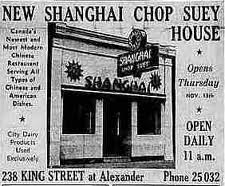
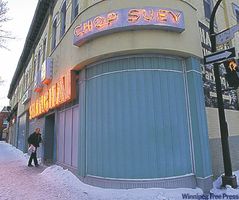
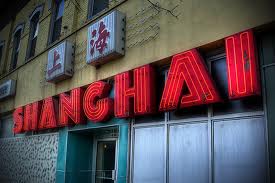
This was not the story I was expecting when it dropped in = we’re used to old restaurant buildings in Shanghai being destroyed but here’s a 140 year old downtown Winnipeg building being demolished. It’s been home to the Shanghai restaurant apparently since the 1940s. Seems to be a bit of a fight about it. Anyway, seemed just about interesting enough to note!
Posted: July 27th, 2012 | No Comments »
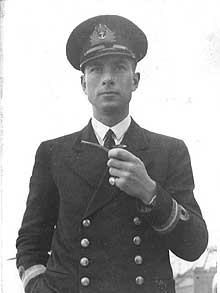
No matter how cool you think you are or how interesting you think your life is or has been Commander John Rigge, who sadly passed away aged 94 this June, is cooler and had a better life. In fact if some smart publisher doesn’t commission a biography of Rigge double quick then they should all be fired – he’s just a writer’s gift. Royal Navy vet, evacuated Brits out of Spain during the Civil War, hunted the Graf Spee, stated his honeymoon on the first day of the Blitz and ended up in the shelter of the Savoy, during WW2 served in the North Sea and Atlantic North-west Approaches and Russian convoys to Murmansk. As if that wasn’t enough he foiled the only known sabotage attack by the Nazis on mainland America during the war, prevented a French ship being scuttled. After the war he served for the Royal Navy in Bermuda and was posted as the Commodore’s Secretary in Hong Kong in the 1950s before becoming a specialist and businessman in Spain. A great life and a full obituary here in the Daily Telegraph.
Rigge was born in 1918 in Shanghai to Winifred and Harry Rigge. Harry was a China merchant trading a range of products – “peanuts to elephants” famously. Rigge was educated at the Cathedral School until he returned to Yorkshire in England in 1926. Those Cathedral School boys!
Posted: July 27th, 2012 | No Comments »
As I’ve mentioned before the series of shorter texts on China I’ve created for the Shanghai Royal Asiatic Society is being launched this late summer by Hong Kong University Press. The new series is featured in their new fall-winter catalogue – I urge you to have a look at them and the whole catalogue – honestly, trust me, this catalogue is a bag of delights with some really amazing titles on history, politics, economics, Hong Kong, China and in the groundbreaking Queer Asia series too. Download or look at the catalogue here….

Posted: July 26th, 2012 | No Comments »
A rather interesting project I’ve been receiving occasional dispatches about reaches fruition with an exhibition in Shanghai worth checking out I feel…
JAMES H. BOLLEN: Jim’s Terrible City
LI WENGUANG: Fallacy
July 29 through August 31, 2012
VIP opening reception: July 29th, 2012, Sunday, 6-8 pm
Venue: James Cohan Gallery Shanghai
Address: 1F, Building 1, No.170 Yueyang Road, by Yongjia Road
James Cohan Gallery Shanghai is pleased to present its summer exhibition by two young Shanghai-based artists, James H. Bollen and Li Wenguang.
James H. Bollen’s exhibition features twelve color photographs from his recently completed book-length project, and the title of his debut exhibition, Jim’s Terrible City. The photographs are inspired by the legendary British writer J. G. Ballard (1930-2009), and Ballard’s semi-autobiographical novel Empire of the Sun. Ballard was born in Shanghai in 1930 in what was then known as the International Settlement. Through extensive readings of Ballard’s highly visual fiction, Bollen explores a literary past and heritage of Shanghai with his own painterly photographic language. The twelve images in the exhibition—all sharing a sense of the unreal—construct an urban landscape where time ceases to exist and life becomes like a stage set. In Bollen’s eyes, violence, flight, car crashes, the incongruities of time and life can seem so immediately cinematic, or a like a ghostly glimpse of life experienced by J.G. Ballard while living in Shanghai during the Japanese Occupation. Many of these themes and images can be tracked throughout J.G. Ballard’s writings, where a near-hallucinatory state of mind merges memories of a Shanghai past while continuing to exist in the city’s present.
See samples of the images here
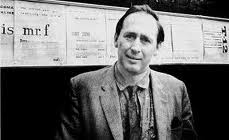
The real JG…
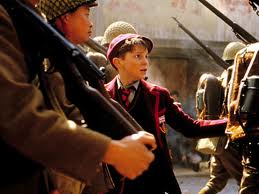
And as portrayed by Batman….
James H. Bollen is a graduate of School of African and Oriental Studies, London University. His work has been shown at the Beach London Gallery, London (2012), SH Contemporary Art Fair, Shanghai (2011) and FotoGrafia Festival Internazionale di Roma, Rome (2010). He works and lives in Shanghai.
Li Wenguang was born in Shanghai. His work has been the subject of a solo exhibition at Stir Gallery Shanghai in 2011; Huating Space Shanghai, Songjiang, Shanghai (2011, 2010); and most recently his work has been exhibited at the Shangyuan Art Museum, Beijing, 2012.
For further information or additional images, please contact Ms. Ivy Zhou at izhou@jamescohan.com or +86 – 21 – 54660825 *602. Gallery hours: Tuesday – Saturday, 10-6 p.m., Sunday 12-6 p.m., and Monday by appointment.
Posted: July 25th, 2012 | No Comments »
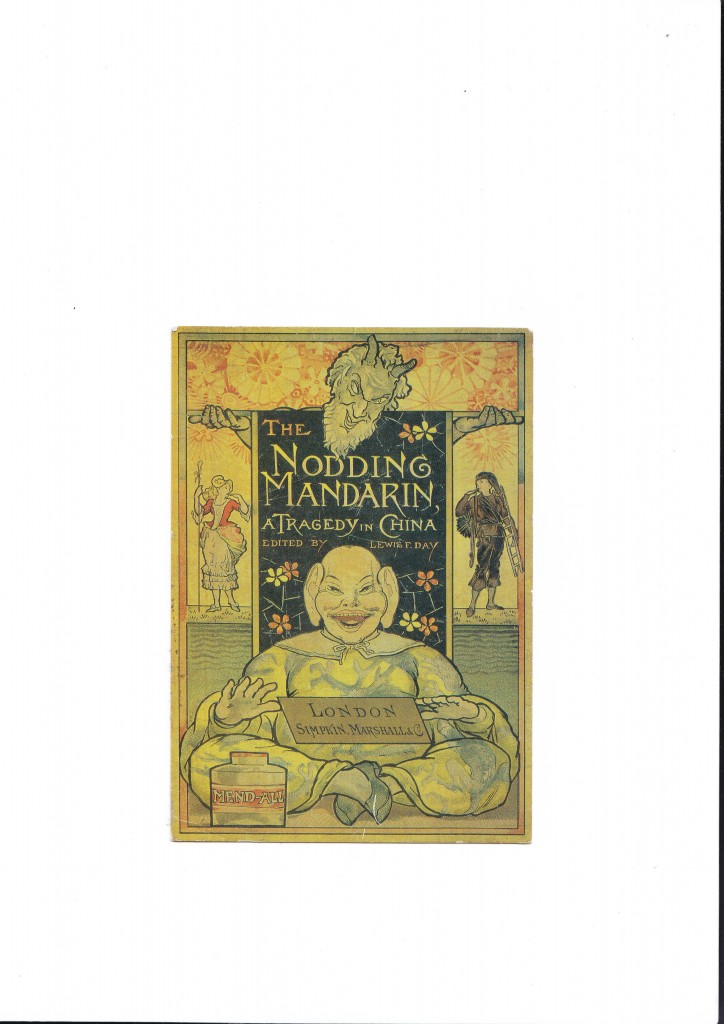
What can I tell you about this? Not much I’m afraid.
Posted: July 23rd, 2012 | No Comments »
As we mentioned Amy Lowell several times a while back in my occasional Year of Chinoiserie Poetry entries (here, here and here) then perhaps we should also note that there is a new biography of her out from Melissa Bradshaw – Amy Lowell – Diva Poet. It’s horribly expensive but perhaps if you have access to a good academic library you can get a look at it.
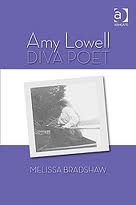
In her reassessment of Amy Lowell as a major figure in the modern American poetry movement, Melissa Bradshaw uses theories of the diva and female celebrity to account for Lowell’s extraordinary literary influence in the early twentieth century and her equally extraordinary disappearance from American letters after her death. Recognizing Amy Lowell as a literary diva, Bradshaw shows, accounts for her commitment to her art, her extravagant self-promotion and self-presentation, and her fame, which was of a kind no longer associated with poets. It also explains the devaluation of Lowell’s poetry and criticism, since a woman’s diva status is always short lived and the accomplishments of celebrity women are typically dismissed and trivialized. In restoring Lowell to her place within the American poetic renaissance of the nineteen-teens and twenties, Bradshaw also recovers a vibrant moment in popular culture when poetry enjoyed mainstream popularity, audiences packed poetry readings, and readers avidly followed the honors, exploits, and feuds of their favorite poets in the literary columns of daily newspapers. Drawing on a rich array of letters, memoirs, newspapers, and periodicals, but eschewing the biographical interpretations of her poetry that have often characterized criticism on Lowell, Bradshaw gives us an Amy Lowell who could not be further removed from the lonely victim of ill-health and obesity who appears in earlier book-length studies. Amy Lowell as diva poet takes her rightful place as a powerful writer of modernist verse who achieved her personal and professional goals without capitulating to heteronormative ideals of how a woman should act, think, or appear.
Posted: July 22nd, 2012 | 2 Comments »
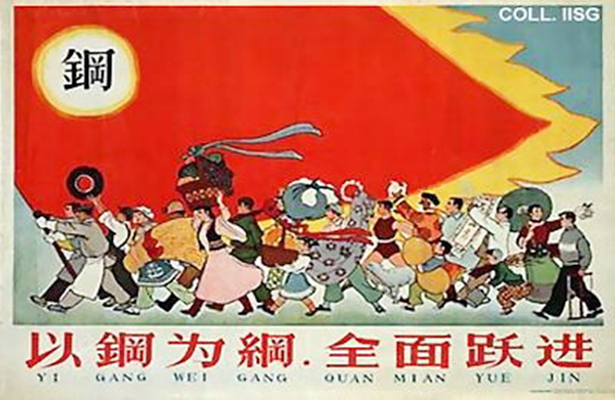
An interesting article in The Atlantic on renewed (or just new really!) discussion on the Great Leap Forward in the wake of the Bo Xilai mess. Of course for those inside China it is extremely hard to access records and texts of scholarship on many aspects of the GLF, just as it with the continued silence around the Cultural Revolution or June 1989.